Learn exactly how long an acre is in miles-both as square miles and side length. Get conversion formulas, real‑world examples, a handy comparison table, and FAQs.
Land Measurement: Understanding Acres, Sq Ft, and How Size Affects Property Value
When you hear land measurement, the process of determining the size and boundaries of a plot of land using standard units like acres, square feet, or hectares. Also known as parcel sizing, it's not just numbers on a map—it's what decides if a piece of land is worth $10,000 or $1 million. Whether you're looking at a backyard in Mulund or a farm in North Carolina, knowing how big something really is changes everything.
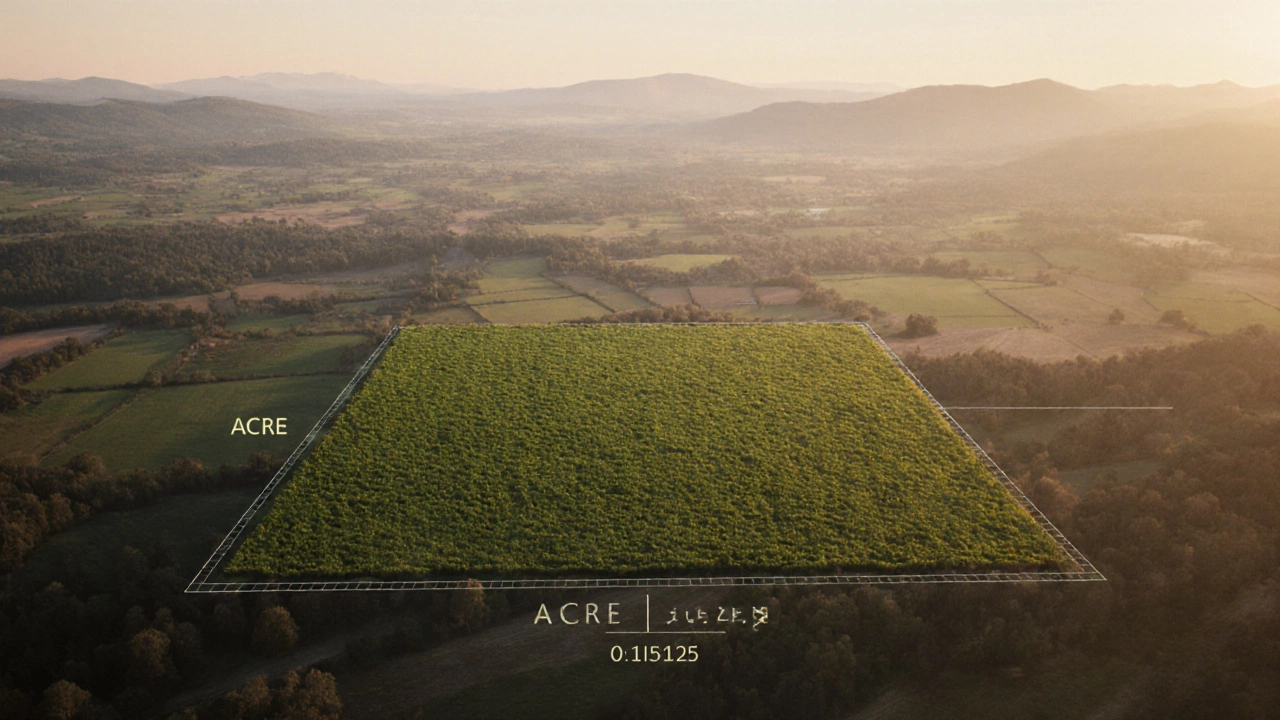
Acres, a unit used mostly in the U.S., India, and other countries for measuring large land areas. Also known as land parcel size, it's the go-to for farms, commercial plots, and rural homes. One acre equals 43,560 square feet—roughly the size of a football field without the end zones. But here’s the catch: two plots both labeled "1 acre" can feel totally different. One might be flat and clear. The other could be rocky, wooded, or flooded. That’s where land size comparison, the practice of relating land area to familiar objects like football fields, basketball courts, or parking spots. Also known as visual land scaling, it helps buyers stop guessing and start seeing. A 100-acre plot isn’t just "big." It’s 75 football fields. That’s not abstract—it’s space for a small village, a vineyard, or a warehouse park.
Then there’s property size, the total usable area of a parcel, including buildings, driveways, setbacks, and any restrictions that limit how you can use the land. Also known as buildable area, it’s not the same as total land measurement. You might buy 5,000 sq ft of land, but if local rules say you can only build on 60% of it, you’re really working with 3,000 sq ft. That’s the difference between a dream and a disappointment. And it’s not just about rules—terrain matters too. A slope, a swamp, or a rocky hill can turn a large plot into a costly headache. Clearing 3 acres in North Carolina? It can cost up to $25,000. That’s not a fee—it’s a reality check.
Why does this all matter in Mulund? Because land here doesn’t come cheap, and sellers don’t always tell you what’s hidden. A plot might look big on paper, but if it’s surrounded by high-tension wires, has no road access, or sits in a flood zone, its real value drops fast. That’s why smart buyers don’t just ask "how big?"—they ask "what can I actually do with it?"
What you’ll find below are real examples from places like West Virginia, Virginia, Utah, and New Zealand—places where land measurement isn’t just paperwork. It’s the difference between a good deal and a money pit. You’ll see how many football fields fit in 100 acres, how much it costs to clear land, and why a 40-acre plot might only support 20 head of cattle. These aren’t theory lessons. They’re lessons from people who’ve been there.