What Is the 2% Rule in Real Estate? A Simple Way to Spot Profitable Rentals

2% Rule Calculator
Calculate Your Rental Profitability
Enter property details to see if it meets the 2% rule for cash flow. The 2% rule suggests monthly rent should be at least 2% of the purchase price.
Buying a rental property isn’t just about finding a nice house. It’s about making sure it pays for itself-and then some. That’s where the 2% rule comes in. It’s a quick, no-fluff way to tell if a rental property is likely to generate solid cash flow before you even sign a lease.
What Exactly Is the 2% Rule?
The 2% rule says that your monthly rent should be at least 2% of the total purchase price of the property. Simple math: if you buy a house for $200,000, you should aim to rent it out for $4,000 or more per month. If you’re looking at a $150,000 apartment, you’d want $3,000 in rent.
This isn’t a law. It’s a rule of thumb used by experienced investors to avoid money pits. A property that doesn’t meet this threshold might seem cheap upfront, but it could eat into your profits with repairs, vacancies, and property taxes. The 2% rule helps you skip those traps early.
Why Does It Work?
Real estate isn’t just about appreciation. Most investors rely on cash flow-the money left over after paying the mortgage, insurance, maintenance, and management fees. If rent doesn’t cover those costs, you’re not building wealth. You’re just paying someone else’s mortgage.
The 2% rule is built on the idea that rent should cover:
- Monthly mortgage payment (principal + interest)
- Property taxes
- Insurance
- Repairs and maintenance (5-10% of rent)
- Property management (8-12% if you hire someone)
- Vacancy buffer (5-7%)
If rent is only 1% of the purchase price, say $2,000 on a $200,000 home, you’re likely barely breaking even-or losing money. At 2%, you’ve got breathing room. At 3% or 4%, you’re in strong territory.
Real-World Example: Auckland vs. Tauranga
Let’s say you’re looking at two properties:
- Property A: A three-bedroom house in Ponsonby, Auckland, priced at $1.1 million. Monthly rent: $4,200.
- Property B: A similar house in Tauranga, priced at $750,000. Monthly rent: $3,100.
Check the 2% rule:
- Auckland: $4,200 ÷ $1,100,000 = 0.38% - way below 2%
- Tauranga: $3,100 ÷ $750,000 = 0.41% - also below 2%
Both fail. But here’s the catch: Auckland’s high prices mean rent growth is slow. Tauranga’s market is more balanced. You might still make money in Auckland if you plan to hold for 10+ years and ride appreciation. But if you want monthly cash flow? Neither works under the 2% rule.
Now look at a $450,000 townhouse in Hamilton with $9,500 monthly rent. That’s 2.1%. That’s the kind of deal investors chase. It’s rare in big cities-but easier to find in growing regional towns.

When the 2% Rule Doesn’t Apply
The rule isn’t universal. In high-demand cities like Auckland, Wellington, or Christchurch, property prices have skyrocketed. Rent hasn’t kept up. You might find a property with a 1.2% rent-to-price ratio-and still make sense to buy it.
Why? Because:
- You’re counting on long-term capital growth
- You’re using low-interest financing
- You’re buying in a suburb with strong population growth
- You’re planning to renovate and raise rent
Some investors use the 1% rule instead (rent = 1% of purchase price) in expensive markets. It’s less strict, but still useful. The 2% rule is for investors who want immediate, reliable income. If you’re buying for appreciation alone, the rule doesn’t matter as much.
How to Use the 2% Rule When Buying Property Online
Buying property online makes it easy to skip the inspection, skip the neighborhood walk, and skip the hard questions. That’s dangerous without a filter like the 2% rule.
Here’s how to use it when browsing listings:
- Find the listing price. Make sure it’s the total cost-include any known renovation costs.
- Check the advertised rent. If it’s not listed, look at comparable rentals on TradeMe, OneRoof, or realestate.co.nz.
- Multiply the purchase price by 0.02. That’s your target rent.
- If the actual rent is below that number, ask: Why? Is it because the area is weak? Is the property outdated? Is the landlord underpricing to get a quick tenant?
- If the rent meets or exceeds 2%, dig deeper: check vacancy rates, council rates, and body corporate fees.
For example: You see a $600,000 property in Palmerston North with a rent of $12,000/month. That’s 2%. Great. But when you check the council rates, you find they’re $8,500/year. That’s $708/month. Add insurance, management, and repairs, and your net profit drops fast. The 2% rule tells you to look closer-it doesn’t guarantee profit, just a good starting point.
What to Do If a Property Fails the 2% Rule
Don’t walk away immediately. Ask yourself:
- Can I renovate and raise the rent? A kitchen upgrade or new flooring might bump rent by $500-$1,000.
- Can I split it into two units? A duplex or granny flat could double your income.
- Is this a short-term rental? Airbnb or holiday lets can bring in 3-4x more than long-term rent-but they’re more work and less stable.
- Am I buying for tax benefits or equity growth, not cash flow?
If none of those apply, and the rent is still below 1.5%, it’s probably not worth it. You’ll end up subsidizing the property every month.
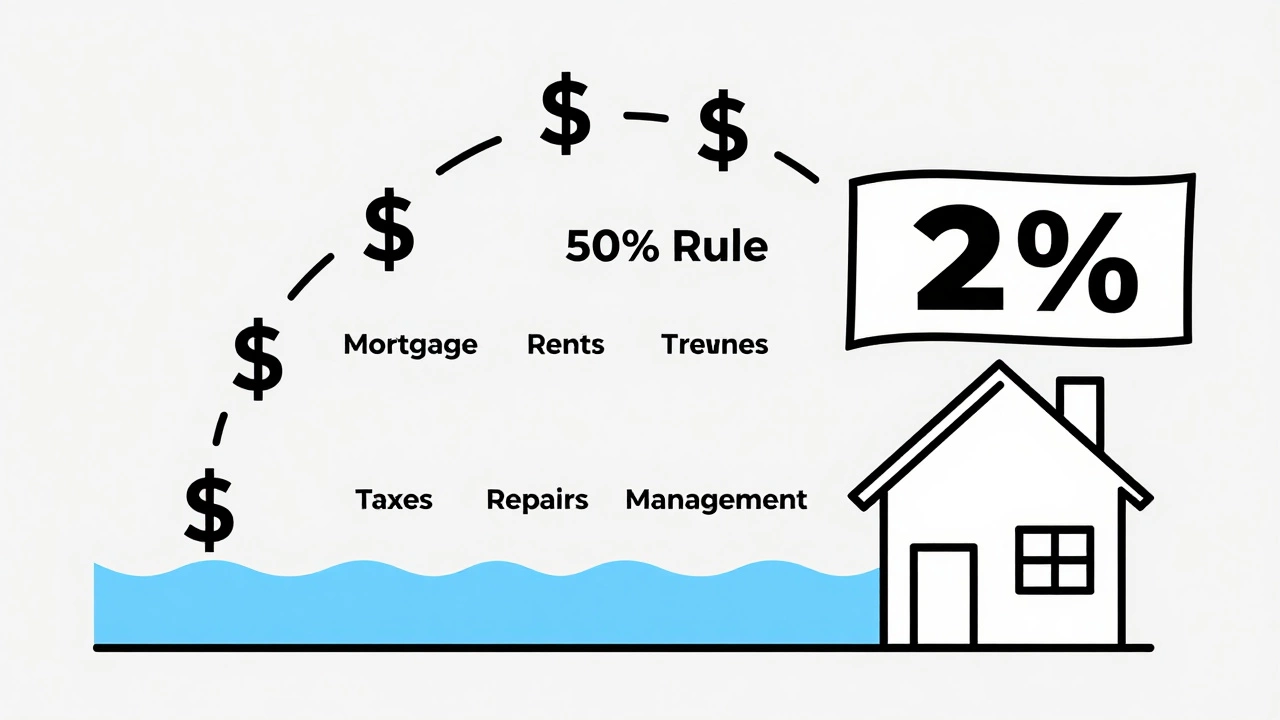
The 50% Rule: The Next Step After the 2% Rule
Once you find a property that hits 2%, use the 50% rule to estimate your net profit.
The 50% rule says: expect half your gross rent to go to expenses. So if you collect $4,000/month in rent, plan for $2,000 in costs. That leaves $2,000 profit.
It’s not perfect. In some areas, expenses are only 40%. In others, they’re 60%. But as a quick estimate, it works. Combine it with the 2% rule, and you’ve got a powerful filter.
Example: $500,000 property, $10,000/month rent. That’s 2%. 50% rule: $5,000 profit. That’s $60,000 a year. That’s not just good-it’s life-changing.
Where to Find Properties That Meet the 2% Rule
Forget the inner suburbs of Auckland. The best deals are often in:
- Regional towns with growing populations (e.g., Whangarei, Tauranga, Rotorua)
- Areas near universities or hospitals
- Properties needing light renovations
- Older homes on large sections that can be subdivided
Use online tools like TradeMe Property, Barfoot & Thompson, and Property Guru. Filter by price and rent. Then calculate the ratio. Most listings won’t show rent, so check similar properties in the area.
One investor in Hamilton bought a 1970s house for $480,000. Rent was $9,800/month. That’s 2.04%. He spent $35,000 on a kitchen and bathroom. Rent jumped to $11,500. Now it’s 2.4%. He’s cash flowing $6,000/month after all costs.
Final Thought: The 2% Rule Is a Filter, Not a Guarantee
The 2% rule won’t tell you if the roof leaks or if the tenant will pay on time. But it will stop you from wasting time on properties that can’t possibly make money.
Real estate investing isn’t about buying the fanciest house. It’s about buying the one that works. The 2% rule helps you find those quickly-especially when you’re scrolling through listings online without ever stepping inside.
If you’re serious about building rental income, use this rule every time. It’s not magic. But it’s one of the few tools that actually separates winners from those who just get lucky.